
In part two of our common misconceptions series we get into some machine design topics and specific cutting applications. If you haven’t read it, be sure not to miss what I discussed in part one.

In part two of our common misconceptions series we get into some machine design topics and specific cutting applications. If you haven’t read it, be sure not to miss what I discussed in part one.

I can’t say I’ve heard them all, but I’ve heard a bunch of them: strange misconceptions about waterjets.
It’s not surprising.
After all, we are cutting with a supersonic waterjet stream (often with a garnet sand added to it) and yet it can cut through a foot thick (300 mm) of metal. People say, “No it can’t!” Actually, yes it can.

As we know, waterjets cut via a supersonic stream. Although there are hand held waterjets used to remove paint, most waterjets are typically moved around with some type of motion equipment.
Waterjets are rather easy to plumb to a machine using elbows, T’s, and other fittings common, in concept, to plumbing a house. Rather than using PVC pipe, we use stainless steel lines of 1/4″ to 9/16″ outside diameter and stainless steel fittings. And motion can be obtained by swivel joints or simply by making the stainless steel line long enough to allow for flexing within the elastic deformation range. Backthrust on the machine is rather small (under 20 pounds [9 kg] for most waterjet applications) even though we are pressurizing the water to very high levels (up to 94,000 psi, or 6480 bar) because not very much water is used (approximately 1 gallon per minute).
Here is a high level overview of the motion equipment that moves around the waterjets.

Today waterjet is one of the fastest growing machine tool processes in the world and has over 30,000 systems installed. But how did it begin? I’ve seen many different claims over the years as to the start of waterjet. There is only one thread – one sequence of events – that I subscribe to, and that is the specific sequence that leads to the commercialization of waterjet for the cutting of soft materials in the 70’s.
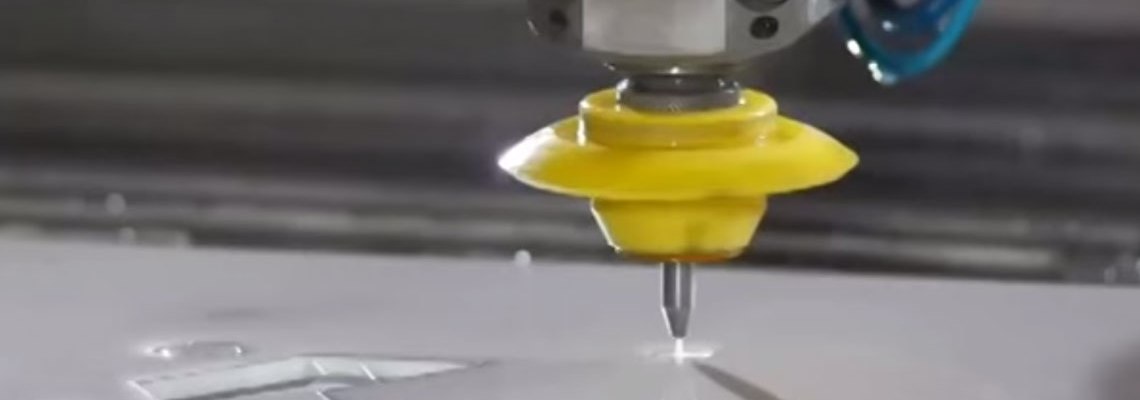
Many processes use heat or produce heat when cutting material.

Waterjets can be attached to a variety of machines. There are hand-held waterblasting wands with rotating tips used to remove paint; stationary jets used for high-speed tissue paper slitting; single axis systems used for cutting baked goods, fiber cement board or other product moving off of a roll; and still others attached to 7-axis pedestal robots used for trimming automotive interiors. But the most common machine used to hold or move a waterjet (or an abrasive waterjet) is the shapecutting machine tool. These are similar to machines that cut with plasma, laser, or router.
With this machine the material is placed (or held) on a work table and the cutting head is moved in an XY plane over top. Sometimes the head has 5 axes of motion for bevel or 3D cutting. I will use the abrasive waterjet shapecutting system in my example from this point forward.
Why should you care about the macroeconomics going on around you?
Well, we all know our business of manufacturing is cyclic, and those cycles are sometimes predicted (and often measured) by large scale trends. These are known as economic indicators. Having a hint of what might be coming is always helpful in making our best business decisions. I don’t pretend to be an expert economist, but in my experience our customers generally see their business rise and fall with key economic indicators.

Let’s start with the basics.
Waterjets are cool. They cut cool – they look cool – and the more you understand how they work and what they can cut the more you appreciate the technology. After 30 years of waterjetting I still marvel at water and sand cutting through super hard materials. It’s just water and abrasive, for goodness sake. How cool is that?!
 FlowBlog